Burr Ledger participates in affiliate programs, meaning qualifying gear purchases through our links may yield a commission at no added expense to you. How Burr Ledger earns affiliate commissions
Manual coffee grinding has shifted dramatically from an exercise in arm fatigue and guesswork into an arena of precision engineering. Where older hand mills relied on tiny thumb wheels hidden underneath the burr assembly, modern high-performance manual grinders feature calibrated external adjustment collars, rigid dual-bearing driveshafts, and specialized conical burr geometries capable of competing directly with premium electric grinders.
Whether your daily ritual revolves around high-clarity pour-overs, dense moka pot brews, or the micro-fine resistance needed for manual espresso, choosing the right hand grinder comes down to three factors: burr geometry and material, adjustment resolution, and mechanical workflow. Below, we examine four distinct options from leading manufacturers across different budgets and brewing applications.
Key Architectural Difference: Internal vs. External Adjustment
External adjustment rings allow you to dial your grind size without unthreading the grounds catch cup or getting coffee oils on your fingers. For brewers frequently alternating between pour-over and espresso, an indexed top collar prevents lost zero points and makes recipe tracking repeatable.
The Premium All-Rounder: 1Zpresso K-Ultra
The 1Zpresso K-Ultra sits at the top end of multi-brew manual grinders. Engineered around a specialized 7-core (heptagonal) stainless steel burr set, the K-Ultra is designed to produce a well-balanced particle distribution that delivers both clean flavor separation in pour-over drippers and sufficient fines for dialing in espresso.
Its primary workflow advantage is the large, externally visible adjustment ring located at the top collar of the body. The numbered dial provides quick tactile feedback and effortless transitions between grind profiles without removing the catch cup. The grinder also incorporates a curved, foldable crank handle that snaps flat against the body, significantly reducing its footprint when stored on a counter or packed into a travel kit.
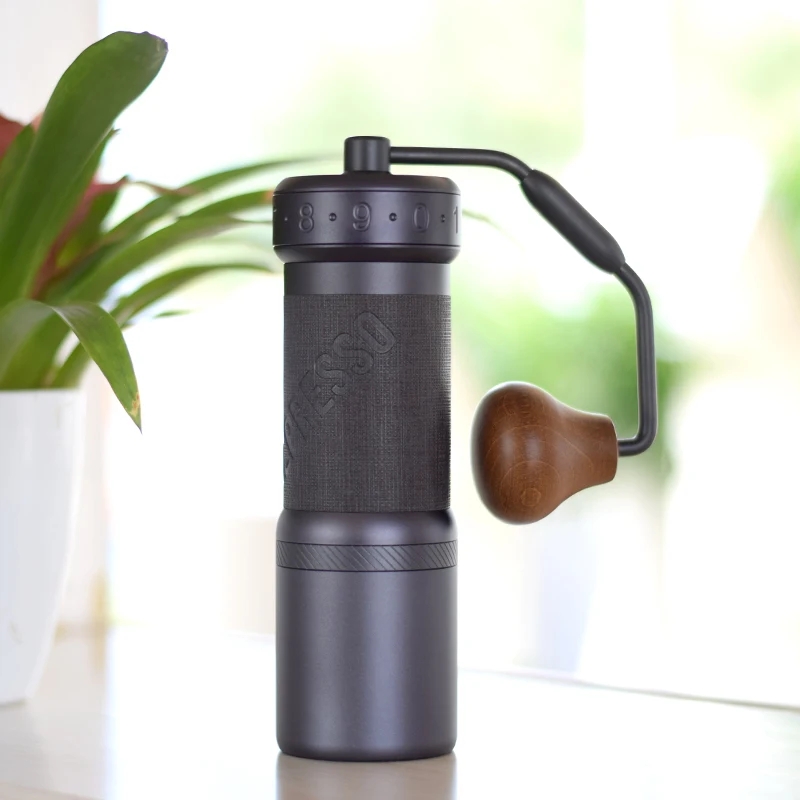
Who it suits: Coffee enthusiasts who switch daily between filter methods (V60, AeroPress, Chemex) and espresso, and who prioritize tactile build quality, external calibration, and packability.
Considerations: As a flagship hand mill, it sits at a substantial price point compared to entry-level alternatives. Brewers strictly seeking high-fines traditional espresso bodies may prefer dedicated espresso geometries, though the 7-core burr performs admirably across the board.
High-Resolution Micro-Stepping: Timemore Chestnut S3
Timemore’s Chestnut lineup has long been recognized for minimalist design and tactile knurled grips. The Chestnut S3 elevates the platform by introducing an external dial ring paired with proprietary S2C890 (Spike-to-Cut) burr architecture and tight 0.015 mm per click micro-adjustments.
The "Spike to Cut" burr geometry functions in two stages: the upper teeth fracture whole coffee beans into coarse fragments before the lower cutting edges shear them to final target size. This progressive cutting action reduces bean shattering, moderates excessive ultra-fine dust, and lowers physical cranking resistance. With 0.015 mm increments per click, the S3 provides granular flow-rate control for dialing in pressurized and non-pressurized portafilters without skipping past the sweet spot.
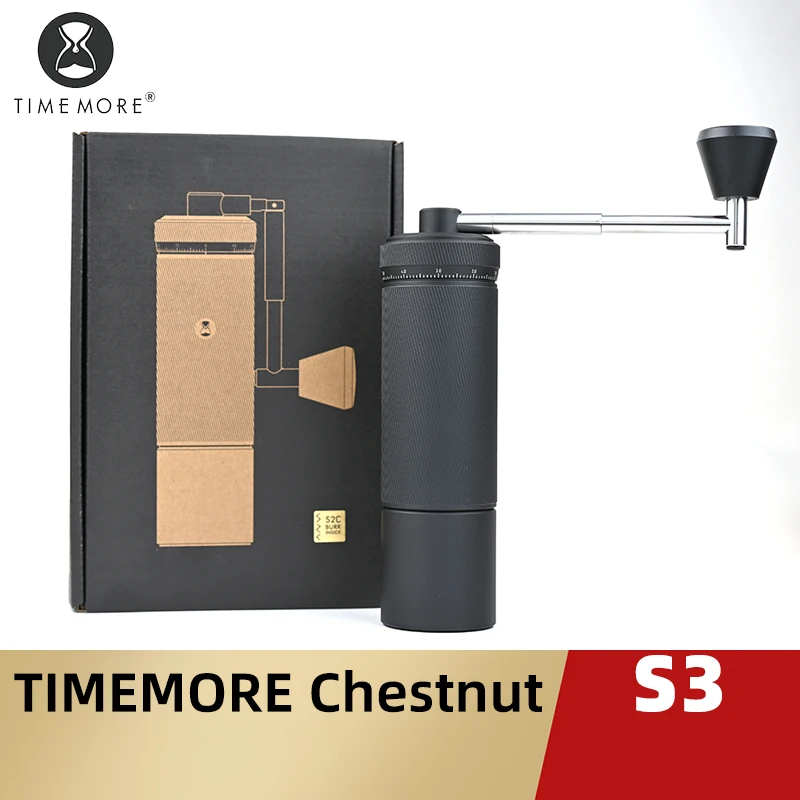
Who it suits: Home baristas looking for dedicated espresso micro-adjustability combined with the convenience of an external top-adjustment dial and a collapsible crank mechanism at a mid-tier price point.
Considerations: While the 0.015 mm resolution makes fine-tuning espresso extraction possible, dialing through dozens of tiny clicks to shift up to coarse French press or cold brew requires multiple complete rotations.
The Value-to-Performance Benchmark: Kingrinder K6
The Kingrinder K6 has earned a strong reputation among home baristas as one of the most capable all-around hand grinders relative to its cost. It features a robust 48 mm stainless steel 7-core burr with titanium plating, engineered to increase surface hardness and extend cutting edge longevity during daily heavy use.
Like the K-Ultra, the K6 employs an external top-adjustment collar marked with clear numerical indicators. The 48 mm heptagonal burr offers rapid throughput, grinding a standard 18-gram dose for filter or espresso noticeably faster than smaller 38 mm hand mills. The silicone body band provides dependable grip when tackling dense, lightly roasted beans.
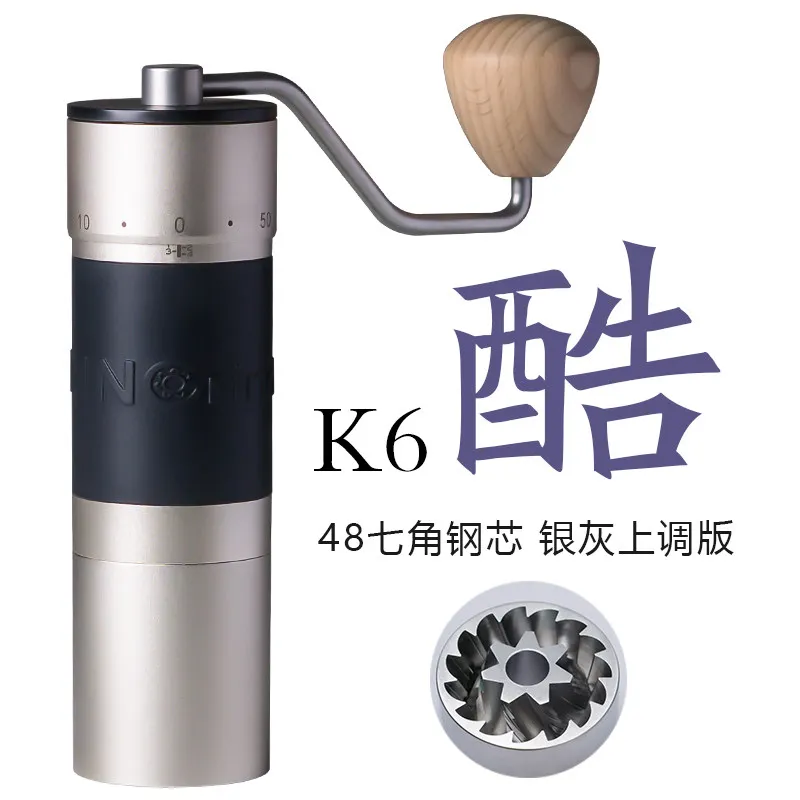
Who it suits: Brewers who want the grind quality, burr diameter, and external adjustment speed of a premium 48 mm grinder without paying top-tier flagship prices.
Considerations: The solid crank arm does not fold flat, giving the K6 a wider lateral profile during transport than folding-handle models like the K-Ultra or Timemore S3.
Accessible Entry Point: Kingrinder P-Series (P0 / P2)
For beginners or travelers who require consistency without metal-body heft, the Kingrinder P-Series (P0 / P2) offers a lightweight alternative built specifically for drip, pour-over, and moka pot brewing. By utilizing high-impact lightweight polymer housing around an aligned stainless steel burr set, the P-series keeps both weight and cost minimal.
While lightweight plastic-chassis grinders from unbranded sellers often suffer from shaft wobble and misaligned burrs, Kingrinder engineers the P-series with internal bearing stabilization to preserve burr concentricity. This prevents the uneven extraction and bitter astringency typically associated with entry-level hand grinders.
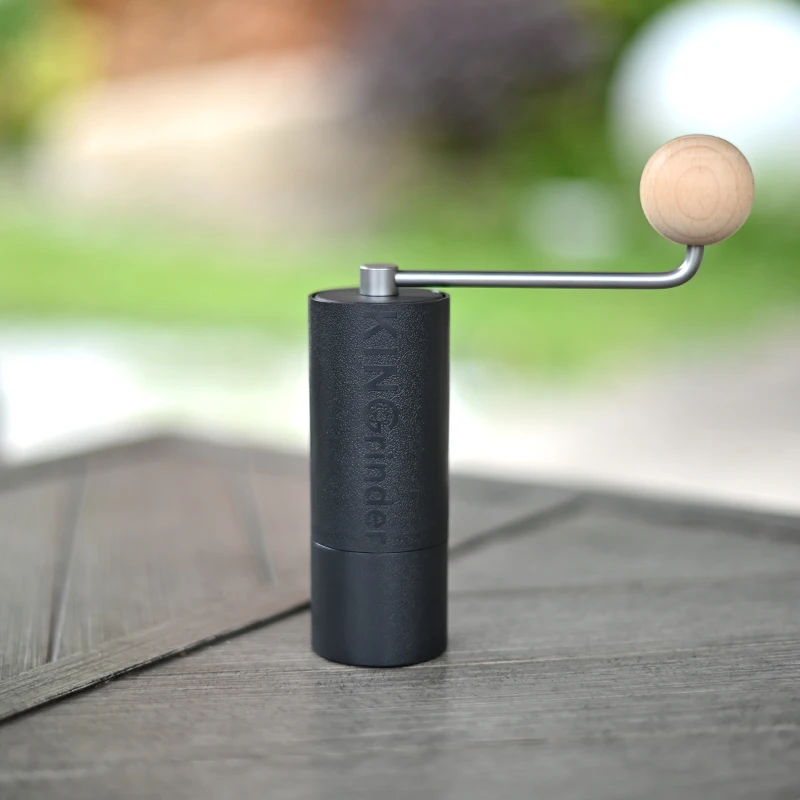
Who it suits: Budget-conscious coffee drinkers stepping up from blade grinders or ceramic burr mills, as well as backpackers wanting a lightweight, durable dripper companion for travel.
Considerations: The P-series uses an internal click mechanism underneath the burr rather than an external ring, making adjustments slower and messier. It is optimized for immersion and drip methods, lacking the micro-stepping resolution required for dialing in espresso.
Head-to-Head Comparison Guide
| Model | Burr Specs | Adjustment Type | Primary Brew Focus | Key Feature |
|---|---|---|---|---|
| 1Zpresso K-Ultra | Special 7-Core Steel Burr | Top External Collar | All-Rounder (Espresso to Pour-Over) | Foldable crank, wide versatility |
| Timemore Chestnut S3 | S2C890 Steel Burr | External Ring (0.015 mm/click) | Espresso & Fine Filter | Ultra-fine click resolution, folding handle |
| Kingrinder K6 | 48 mm 7-Core Titanium-Coated | Top External Collar | All-Rounder (Espresso & Filter) | High grinding speed, exceptional value |
| Kingrinder P0 / P2 | Stainless Steel Burr | Internal Step Dial | Moka Pot, Aeropress, Pour-Over | Lightweight portable chassis, budget-friendly |
How to Make Your Decision
- Choose the 1Zpresso K-Ultra if you want an uncompromising, premium hand grinder with intuitive external adjustments and a folding handle designed to transition smoothly across all manual brewing methods.
- Choose the Timemore Chestnut S3 if you require pinpoint espresso calibration with 0.015 mm click intervals and appreciate the progressive two-stage cutting geometry of Timemore's S2C burrs.
- Choose the Kingrinder K6 if your goal is 48 mm titanium-coated burr performance and external dial convenience at a highly competitive mid-range price point.
- Choose the Kingrinder P-Series if you need an affordable, lightweight hand mill strictly dedicated to filter, moka pot, or travel brewing where micro-fine espresso settings are not required.